
The Creative Nonfiction Story
By Lee Gutkind
How a little magazine defied resistance and ridicule and helped launch the true-story revolution
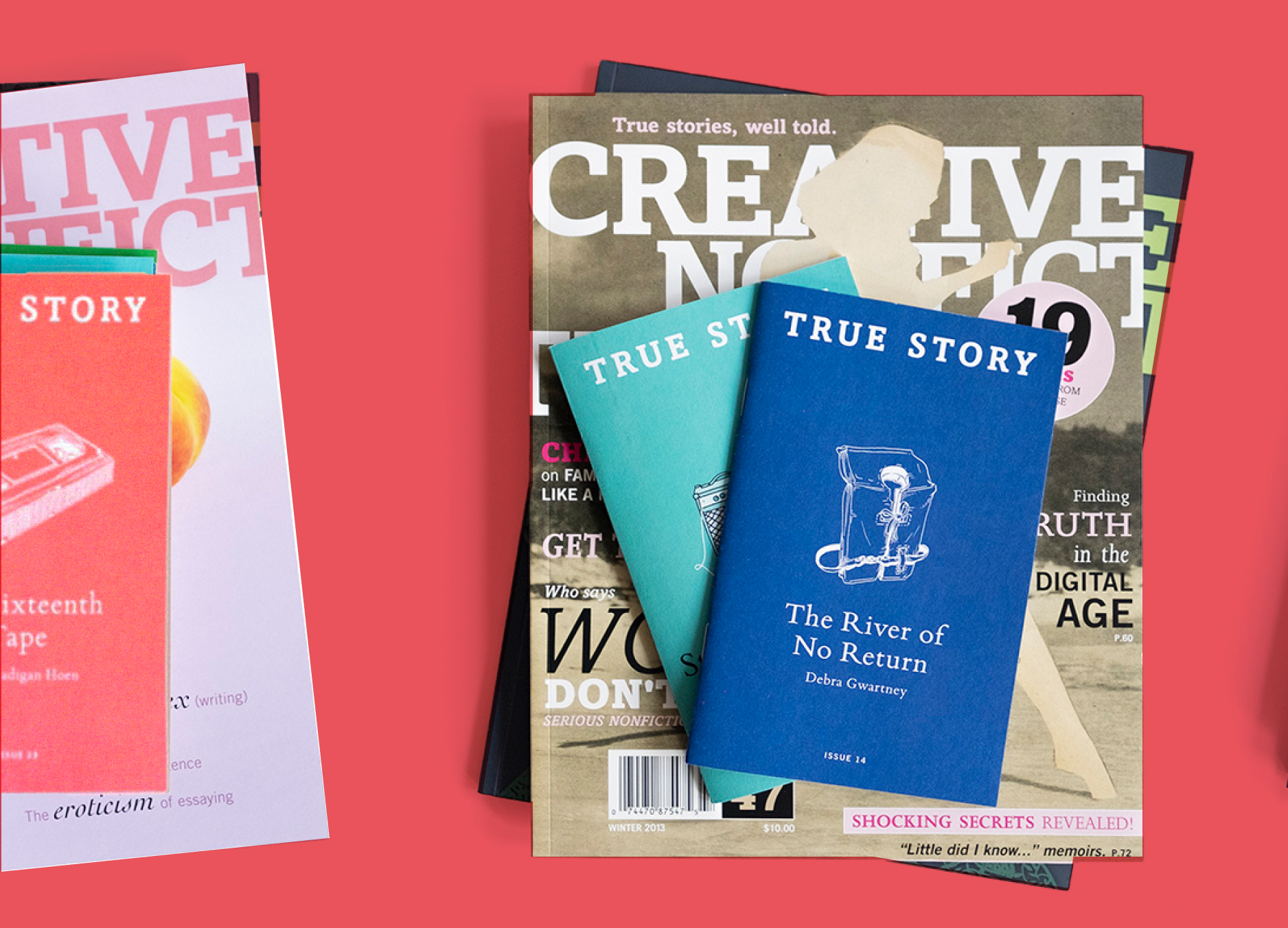
Creative Nonfiction first appeared in 1994—a plain, traditional perfect-bound literary journal. No photographs or illustrations. Just essays.
Well, they really weren’t just essays. Essays at the time, most people believed, were scholarly, esoteric, often tedious and boring. Publishers shuddered at the “E” word. Who, they wondered, would ever read collections of essays, except for friends and colleagues of the writers—if even that? But the essays published in this first issue were very different than the traditional essay: they were dramatic, exciting, and surprising, not at all scholarly. Lots of scenes, dialogue, and characters confronting adversity and trauma and achieving clarity and resolve. They were journalistic in that they provided interesting and accurate information, but they read like short stories—almost—narratives that were rarely permitted in newspapers, magazines, and literary journals at that time. Yes, The New Yorker and Esquire were exceptions, but an unlikely destination for writers with limited experience.
Creative writing programs in English departments paid little attention to nonfiction at the time, whether or not it was deemed “creative.” Even the essay was not considered an endeavor equal to poetry and fiction. Or, with few exceptions, worthy enough to deserve degree status. This was ironic considering the literary legacy of the essay—beginning with Michel de Montaigne, father of the modern essay, and later, in the eighteenth century, Daniel Defoe’s historical narratives, Benjamin Franklin’s autobiography, Thomas Paine’s pamphlets, and, later still, Charles Dickens, Henry David Thoreau, Mark Twain, and Virginia Woolf.
Throughout the next decade, many people in the academy and the journalistic community made light of this new or unorthodox way of writing, this nonfiction that was true and accurate and creative at the same time. Some of the pushback was quite mean-spirited. Michael Anderson, an editor for The New York Times Book Review, characterized the idea of creative nonfiction as “bullshit… . If it is creative, then it’s not nonfiction and if it is nonfiction, it is not creative.”
For a long time, both journalists and academics harped on the lack of a definition of creative nonfiction. Interviewing me for a feature article in Poets & Writers magazine ten years after the magazine was launched, Carolyn Hughes insisted that I define creative nonfiction.“What is it?” she asked, “journalism lite? … (I)s the category,” she added, “necessary at all?”
I had been asked this definition question frequently over the years, even before the magazine began, and I invariably declined to answer. Creative nonfiction should be regarded as an art, I insisted, as open to interpretation and experimentation as poetry and fiction. I admit I was more than a little defensive when asked this question. This was the kind of writing I had been doing for many years. I had published books and essays and devoted a great deal of my professional efforts to the journal and teaching creative nonfiction. I felt that what I and many others were writing was as challenging—and in certain circumstances even more so—as fiction or poetry. Hughes was annoyed by my refusal to provide a definition. Or maybe she was delighted, so that she could write the following observation: “Alas, therein lies the rub. If one of the leading lights of a genre will not define it, the door is open for people to conclude, to echo Gertrude Stein’s assessment of her home, California, ‘there is no there there.’”
But there was something there, a hell of a lot in fact, even though quite rightly it could not and should not be defined. For despite the resistance and criticism, the idea of writing nonfiction that was personal, intimate, and cinematic, with writers opening up and exploring all possibilities, employing the tools of storytelling—first gradually and then rapidly—caught on.
Writers who had struggled with what to call their work that was neither poetry or fiction were emboldened, and they embraced the phrase and the freedom and flexibility it provided. Creative nonfiction was, in many ways, a release. It allowed and encouraged writers of poetry and fiction to cross genres, reach for new ideas, and find fresh ways of expression. I will never forget how delighted and, I admit, astonished I was to discover Charles Simic’s essay “The Necessity of Poetry” in our slush pile. Here was a Pulitzer Prize-winning poet recreating a series of memory fragments that brought to life his boyhood during the bombing of Belgrade—and revealing intimate details, like why he was wearing a Nazi helmet)—and his life as a poet in Chicago and New York. It captured in less than five thousand words the essence of his life.
Many of the essays we published prove the flexibility and potential of the genre; we were open to anything that pushed literary boundaries to their nonfiction limits. As time passed, writers were using the storytelling techniques of the genre to confront important issues that face us personally and as a nation: how we choose to die, ecological disaster, and the quest to save life with organ transplantation.
This is exactly what I had hoped for when I started the journal: that creative nonfiction would not just be an accepted genre in the literary world, but that it also would allow writers to confront the most serious and personal issues, reach readers who may have no interest in a subject or even fear its reality, but cannot resist the richness, honesty, and beauty of a true story.
It took a while, but the academy eventually embraced creative nonfiction and its virtues. I helped start the first MFA programs in the genre, both at the University of Pittsburgh and, in 1997, the first low-residency program at Goucher College. As I write this, there are more than 200 MFA creative nonfiction programs and three dozen PhD programs—not just in the US but in Asia, New Zealand, Australia, Ireland, the UK, and other countries. Nearly every week, creative nonfiction books appear on the bestseller lists of The New York Times and The Washington Post; they are featured and reviewed and excerpted in major magazines and on literary websites. Many newspapers today, once critical of creative nonfiction (and the New Journalism in the 1960s and 1970s) regularly solicit and publish personal essays for opinion and feature pages. News stories, once limited by the five W’s—who, what, when, where, why—are often written as dramatic narratives.
I like to think, and perhaps many would agree, that the establishment of this journal, the first to publish creative nonfiction exclusively, and to campaign for its legitimacy, had a lot to do with the transition and acceptance of this outlier genre in a variety of important ways.
In every issue we introduced new writers along with well-known writers experimenting with the form: recipients of the National Book Award and the Pulitzer Prize in nonfiction and poetry, along with accomplished best-selling novelists and short-story writers. Some of the writers appearing in all seventy-eight issues were just emerging or published for the first time. We established a platform that allowed writers and readers to discuss, dialogue, and explore the essence of the genre. We debated and clarified many of the ethical issues of the genre—inevitable when writers are encouraged to experiment with style and structure and reveal precious secrets that they never before dared to share. We worked very hard to defend the genre against criticism and ridicule by publishing special issues and, when necessary, ambitious advocacy. We were from the beginning considered “the voice of the genre.”
Perhaps more than anything else, Creative Nonfiction provided a rare publishing destination. It opened the doors to all writers of all genres—and not just professional writers but also people outside the literary mainstream: doctors, engineers, police officers, scientists, and anyone else with a factual, dramatic story to tell. We made a special and ongoing effort to feature the work of women writers who, perhaps because of the more personal content of their work, often found acceptance of their essays more challenging. In the beginning, in 1994 and for years after, very few literary journals were interested or open to this work. Creative Nonfiction came to life at exactly the right time, and before long, what seemed like a blink of the eye, we were deep into the true-story era.
For our thirty-eighth issue we became a quarterly magazine—with provocative illustrations, essays on craft, and interviews of the most innovative writers practicing creative nonfiction. We sponsored conferences, established a popular education program, launched a book imprint, partnered on special issues with the storytelling platform, Narratively.Com and Arizona State University and established programs that introduced the techniques of creative nonfiction to scientists, which were supported by the National Science Foundation. We even created and published a pocket-sized monthly magazine, aptly named True Story. Amazing, considering our very humble beginnings with that tiny journal in 1994. That first issue had 173 subscribers.
Today, creative nonfiction is not just an idea or a reason to debate. It is a legitimate and accepted genre worldwide. It is remarkable, as I look back thirty years, surveying our archives, how far we have traveled and how many wonderful writers who have shared their ideas and work over seventy-eight issues. This invaluable literary legacy is now forever preserved and freely available to anyone at Duquesne University’s Gumberg Library.
As for me, it’s been a wild and surprising journey. I never expected that Creative Nonfiction would have existed for so long and made such a long-lasting impact. I move on with hopes that we will always write our true stories with passion and daring, never abandon our ideas and dreams, believe in ourselves despite criticism and resistance. That is the true story of creative nonfiction: an idea and a genre no one wanted or believed in that eventually earned its place in the literary world, and the little magazine that helped make it happen.
Reprinted in part from the Introduction to Creative Nonfiction: The Final Issue, The Best of Thirty Years of Creative Nonfiction.